
Industries
College and University Cleaning in San Francisco
College and university cleaning in San Francisco that starts where students spend their days, in lecture halls and libraries, then covers residence halls, unions, rec centers, teaching labs and offices on the schedule and rules your campus sets.
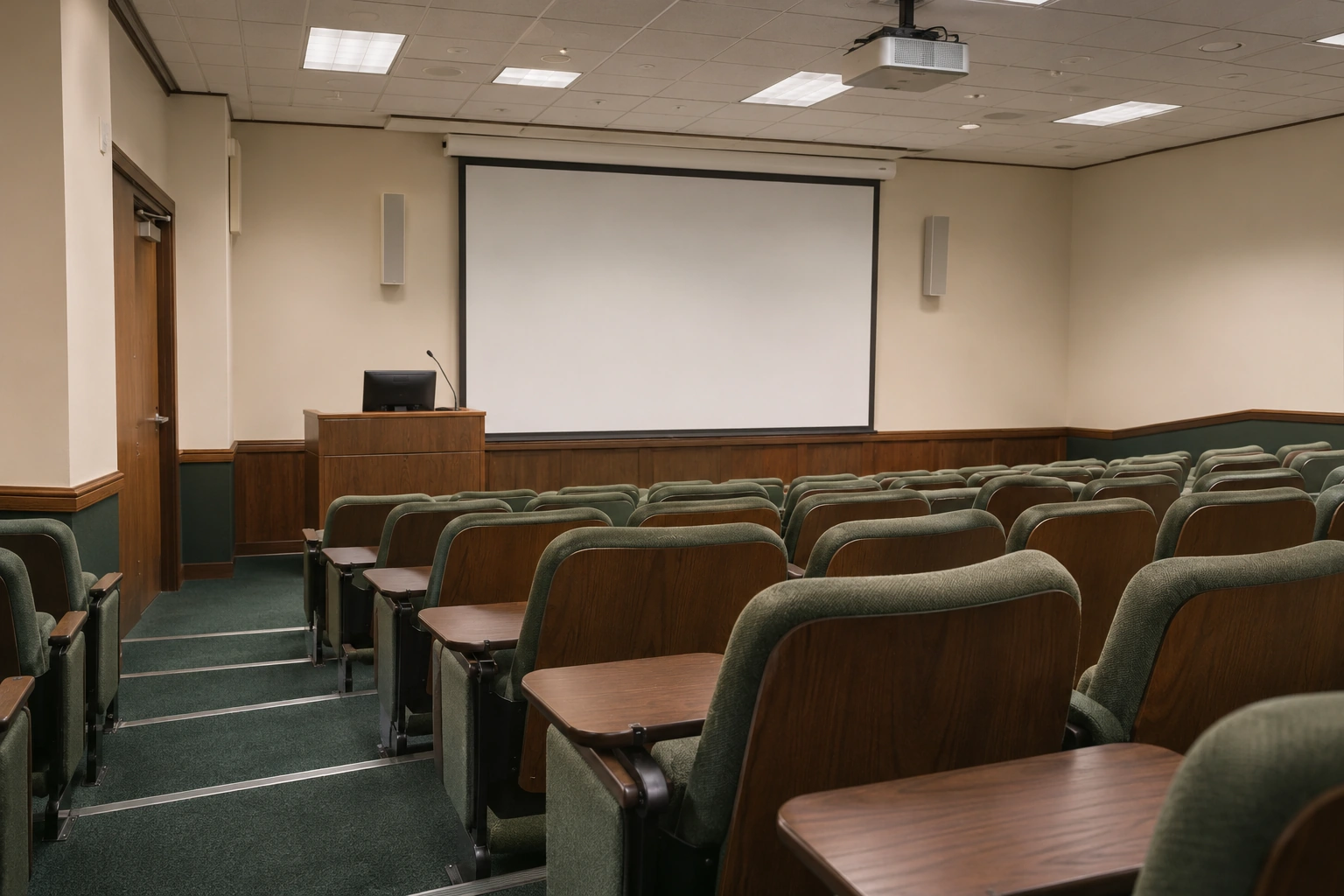
Lecture halls ready by the first class
College and university cleaning on a San Francisco campus starts in the rooms students fill all day. A large lecture hall carries back-to-back sections from morning to evening, and by night it shows: cups under the seats, handouts in the aisles, smudged boards and a lectern covered in fingerprints. That is why SF Janitorial puts lecture halls at the head of a campus route, cleaned after the last evening section so the morning class walks into an ordered room.
Every row gets its seat backs, armrests and writing surfaces wiped, and the aisles and steps are vacuumed or damp-mopped to suit the floor. Down front, the instructor’s table, the lectern, the writing boards and their trays are cleaned, along with the door pulls, light switches and stair rails that the CDC counts among the high-touch surfaces worth cleaning on a regular schedule. Trash and recycling leave the room, and loose chairs go back into their rows.
Smaller classrooms and seminar rooms follow the same pattern at a smaller scale. For comparison, one UC campus’s facilities page lists daily trash removal, board, desk and table cleaning, chair alignment and vacuuming for its classrooms, with dusting every two weeks. That is one campus’s schedule rather than a norm; your facilities office decides how often each room is done.
Libraries and quiet study floors
Libraries stay busy long after the classrooms empty, and the people in them came for quiet. Crews wipe study tables, carrels, service desks and the counters where students charge laptops, empty the bins, clear the group study rooms and set the chairs back. Restrooms on each floor are cleaned and restocked so a late study session does not end at an empty dispenser.
Noise sets the timing. In its cleaning operations chapter, APPA, the association for educational facilities, notes that cleaning during the day can put noisy equipment and dusting right next to people who are working. So vacuuming in reading rooms and along the stacks moves to the hours the library is closed, or to a floor your staff have closed off. For indoor air, the same chapter points to vacuums with HEPA filters and to chemicals low in VOCs, which suits rooms where students sit for hours. Shelf tops, end panels and window ledges within reach are dusted on whatever rotation library staff choose.
If you run buildings on a campus
Facilities directors, custodial and building services managers, housing managers and auxiliary services teams at San Francisco colleges and universities each need something different from a cleaning crew. You might need one academic building covered, a cluster of halls on a shared route, or a crew to fill gaps beside your in-house custodians, all handled through the same nightly janitorial services SF Janitorial provides for offices and shared buildings.
On many campuses the union, housing and dining buildings answer to a different office than the classrooms do. At some schools the central custodial service leaves out housing, the union, the cafeteria, the bookstore and foundation buildings altogether. So the office that owns each building signs off on that building’s task list. K-12 schools, preschools and childcare centers have their own page on school and daycare cleaning; this one covers higher education.
College and university cleaning beyond the classroom
Past the lecture halls and libraries, each campus building gets a list of its own, because each one is used differently. The table below shows the routine work and the bigger jobs that tend to wait for a quiet week. Your facilities office sets the frequency for both.
| Space | Routine cleaning | Bigger work, booked separately |
|---|---|---|
| Lecture halls and classrooms | Seats and writing surfaces, boards and trays, lecterns, trash and recycling, floors | Carpet extraction, and scrubbing or refinishing hard floors over a break |
| Libraries and study rooms | Tables, carrels, desks, bins, study-room boards and floor restrooms | Reading-room carpet extraction and interior glass |
| Residence halls | Bathrooms, lounges, hallways and stairwells while students live in | Vacated rooms cleaned between move-out and the next arrivals |
| Unions and dining commons | Seating, tables, entries, lounges and restrooms | Floor scrubbing and added passes on event days |
| Recreation centers | Locker rooms, showers, machines and studios, as our gym and fitness center cleaning describes | Rubber and tile floor scrubbing |
| Teaching labs | Floors, bins and restocking, with bench tops cleaned as the lab directs | Only what the lab’s protocol allows, as on our cleanroom, data center and lab cleaning page |
| Administrative and department offices | Desks as staff leave them, bins, kitchenettes and meeting rooms | Carpet extraction and interior glass |
| Restrooms, lobbies, elevators and stairwells | Fixtures cleaned and disinfected, dispensers filled, drinking fountains, handrails and elevator buttons wiped | Restroom deep cleaning and lobby or stair floor refinishing |
Paper towels, soap and liners can come with the service through janitorial supplies. Surfaces are cleaned before they are disinfected, as the CDC advises, and disinfection and sanitizing adds extra passes on touchpoints in busy weeks or whenever your campus asks for them.
Campuses across San Francisco
Higher education in San Francisco takes in public, private, two-year and graduate schools, some on one large campus and others spread across buildings in several neighborhoods. Each one runs its own facilities operation and writes its own custodial rules, so your cleaning plan starts from yours.
Appearance levels and campus rules
How clean each building should look is your campus’s call. Plenty of facilities offices put that target in terms of APPA’s five appearance levels. They run from Level 1, which APPA calls orderly spotlessness and pairs with showpiece buildings, down to Level 5, unkempt neglect. In between, Level 2 lets a little dust or a few streaks show on close inspection while restrooms stay at the top standard, and Level 3 lets stains and build-up in corners become visible.
If your office works with those levels, tell us the target for each building and the task frequencies behind it, and the cleaning plan is written to match. APPA’s chapter says service levels should be set together with building users and custodial staff, then written down clearly so everyone can see which tasks happen and on what cycle; a written scope of work does exactly that. Supervisors then carry out quality inspections against your list, not against a level we pick for ourselves.
How the school year shapes visits
Term time means steady evening work in lecture halls, libraries and offices. Finals shift the load: libraries and study rooms stay full late, so their restrooms and bins can get extra passes while machine work keeps clear of students who are studying.
Move-out leaves residence halls with empty rooms to clean before the next group arrives. Halls that host summer conference programs need a thorough clean before guests arrive, then steady care of bathrooms, lounges, hallways and stairwells while they stay. Crews take on both kinds of turnover on the dates your housing office sets.
Summer and winter breaks free up empty buildings for the larger jobs: carpet extraction in reading rooms and offices, and scrubbing, recoating or stripping and refinishing through commercial floor care in corridors, lobbies and classrooms. Street-level glass can join the list through low-rise window cleaning.
Campus access and chemical safety
Crews work under the campus’s key, card and access rules. Contractor keys and cards often carry an expiration date and one copy per holder, and your campus decides which ones our crew carries and how they come back.
Screening follows the same logic. The CSU’s systemwide background check policy makes contractors responsible for checking employees who do work the CSU treats as sensitive, and requires checks for anyone in regular contact with minors, such as at campus-hosted camps. SF Janitorial’s crews are insured, bonded and background-checked, and your campus decides whether its own screening applies on top.
For chemicals, California’s hazard communication standard (8 CCR 5194) asks employers who share a workplace to set out how they will tell each other about hazardous chemicals, for example by sharing access to Safety Data Sheets, and it expects those sheets to be readily at hand during every shift. Ask us for the sheets that go with the products our crew brings, and our SDS binder guide shows one way to file them. Crews are trained in bloodborne-pathogen safety, and campus clinics and exam rooms are cleaned to the clinic’s own protocol.
Evening crews, porters and event help
Most academic buildings are cleaned in the evening or overnight, once classes end. APPA treats daytime, swing and overnight cleaning as options, with the choice made together with building users and custodial staff. Its list of daytime benefits includes visible staff who can fix problems quickly, so a day porter can look after a union, a library entrance or a busy restroom block during open hours while the main crew works after dark.
Events add their own work. One Northern California private university’s event custodial policy, for example, lists a refresh before an event, trash patrols and restroom checks during it, and heavy cleanup before the next day’s routine service, and it wants requests a week or more in advance. Evening and weekend visits are part of how SF Janitorial schedules, so open houses, conferences and commencement weekends can go on the schedule as extra visits.
Get help pricing your campus buildings
A rough list of buildings and their open hours is enough to start. We walk the spaces with your facilities lead, note the room types, floors and access rules, then put routine cleaning and break-time projects on separate lines of a written quote. See what happens on a janitorial walkthrough, or request a campus walkthrough when the timing suits you.
A few useful answers
Common questions
Are lecture halls cleaned every night during the semester?
Yes, when that is the schedule your facilities office sets. Each hall gets its own frequency, from nightly cleaning through the semester to floors done on alternate days, and the plan follows what you pick.
How do you keep the library quiet while it is cleaned?
Wiping tables, carrels and desks is quiet enough to do while the building is open. Vacuuming and other machine work waits for closed hours or a floor your staff close off, and library staff choose the dusting rotation for the stacks.
We use APPA appearance levels on campus. Can you plan around them?
Yes. The level is your choice and your measure. Give us the target for each building, and its task list and frequencies are written to match; we never grade our own work with an APPA level.
Can residence halls be turned around after move-out?
Yes. Vacated rooms, bathrooms, lounges, hallways and stairwells are cleaned between move-out and the next arrivals, whether those are fall students or summer conference guests, on the dates your housing office sets.
How is a teaching lab cleaned?
On the days the lab chooses, crews clean the floors, empty the trash and restock supplies, wipe bench tops the way your lab directs, and follow the lab’s own entry steps and approved products on every visit.