
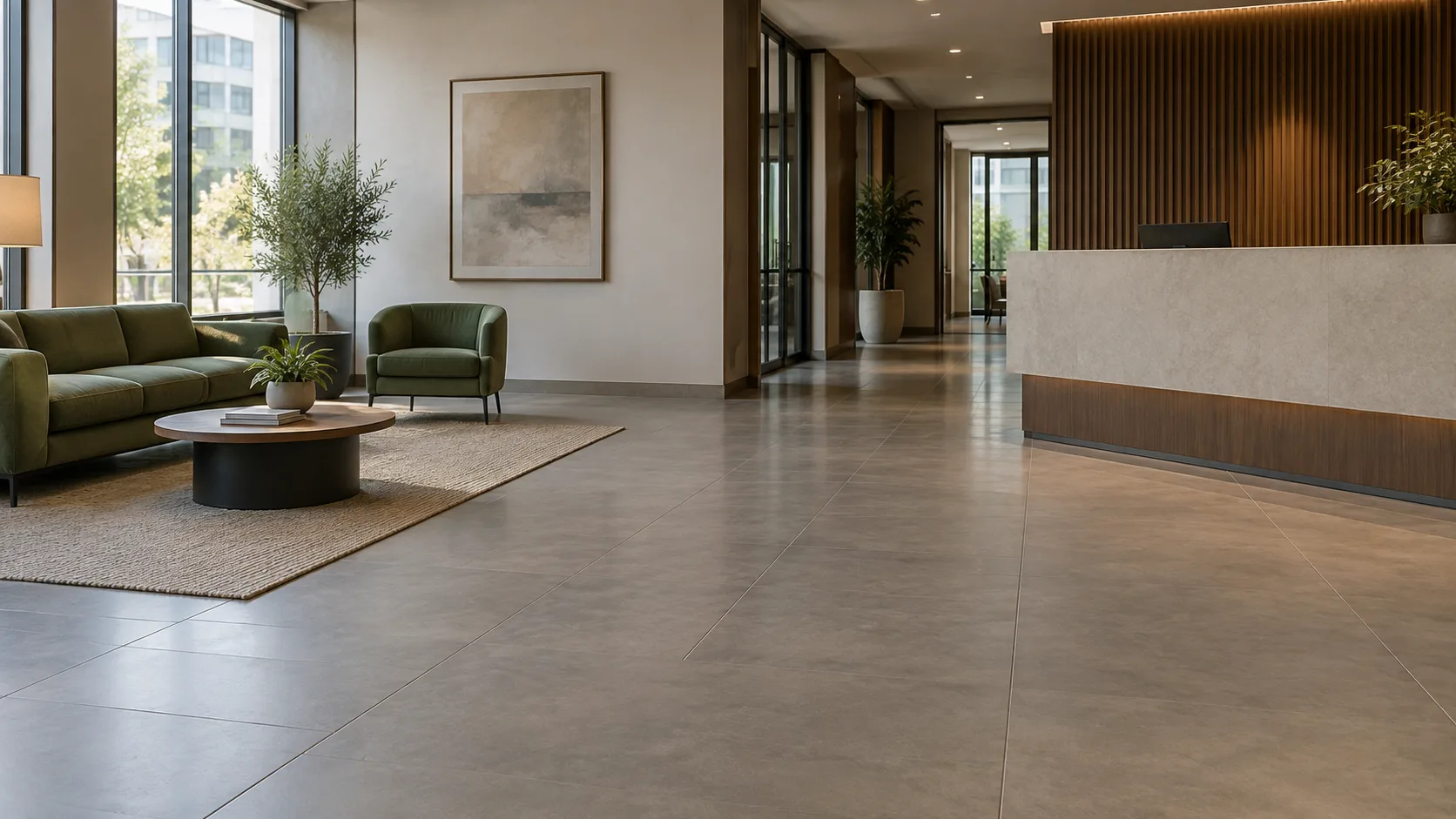
Commercial floor care in San Francisco
Hard floor cleaning and finish maintenance for San Francisco offices and commercial properties.
Periodic care for hard floors
Scrubbing lifts the soil that routine mopping leaves behind, and burnishing, recoating and polishing bring a worn finish back to a shine. We pick the method for each floor.
Stripping and waxing
On VCT and other resilient tile, stripping takes the worn finish off down to the tile, and fresh coats of finish go down in its place.
Concrete and natural-stone surfaces
Machine scrubbing lifts tire marks, old spills and ground-in grime from concrete in warehouses, loft offices and back rooms, and the price follows the floor’s size, condition and access. Marble and terrazzo get stone care: a cleaning made safe for the stone, then polishing that brings back the shine foot traffic wears away.
Cleaning around your business hours
Burnishing, recoating and strip-and-wax are done at night or on weekends, so floors are dry by the time you open.
Matching the treatment to the floor
Commercial buildings often carry several hard floor types at once: VCT in a breakroom, natural stone in a lobby, coated concrete in a warehouse office. Each gets its own treatment, from stripping and waxing to scrubbing and burnishing, chosen for the material and the condition we find.
Because treated floors need time before people walk on them, the work is usually planned for evenings or weekends. Pair it with recurring janitorial service for everyday sweeping and mopping, and see industrial cleaning for warehouse concrete.
Burnishing, recoating and stripping as one cycle
These three treatments work together on finished resilient floors. Burnishing polishes the existing finish at high speed to bring back its shine, and it comes around most often on heavy traffic paths such as lobbies and corridors. Recoating adds fresh layers of finish over a scrubbed surface once burnishing alone no longer restores the look.
Stripping and waxing sits at the end of the cycle. When the finish has worn through or yellowed, the old layers come off completely and new finish goes down. Spacing out the strip with steady burnishing and timely recoats keeps a floor looking good for longer between full refinishes, which also means fewer weekends with rooms closed off.
Floors across San Francisco properties
Lobbies in downtown towers often feature marble or terrazzo, which is cleaned and polished rather than waxed. Converted loft offices in SoMa and Dogpatch tend to have concrete in open work areas alongside resilient flooring in kitchens. Restaurants and retail spaces put their finishes under constant foot traffic, and hotel lobbies and corridors need floors that look ready for guests at any hour.
Each of those settings changes the timing as much as the method. A hotel lobby is treated in its quietest hours, a bank lobby after the branch closes and a restaurant floor once the last table clears. The bank and financial office page shows how floor work fits into a branch routine.
Getting a space ready for floor work
Before a floor visit, clear the rooms being treated of chairs, bins, mats and anything stored on the floor, or tell us which items stay so the plan accounts for them. Share what you know about the floor’s history, such as the last strip or the type of finish, since that shapes the method. Keep the area closed for the drying time we give you when the work is booked.
What floor stripping and refinishing runs in San Francisco
A full strip and refinish on resilient tile in San Francisco is typically $0.50 to $1.00 per square foot, per published 2026 market rates, with a minimum charge per visit. Open, well-kept floors begin near $0.39. The top of the scale, up to $3.00 a foot, applies to small rooms with heavy buildup, where the visit minimum is spread over only a few hundred feet.
Here is how a single project adds up. A 1,400-square-foot breakroom and corridor of VCT, stripped and refinished at $0.85, comes to $1,190. A lighter cycle of scrubbing and recoating on that same floor runs below a full strip, and burnishing between treatments costs less again, which is why floor work is best planned as a cycle instead of a one-off.
Several layers of yellowed finish take longer to remove than one worn coat, and furniture, fixtures and tight doorways slow the machines. Natural stone in a lobby and coated concrete in a warehouse office use different methods and are priced apart from tile. Drying time matters in a city where many businesses open early, so a large floor that has to be split across several nights costs more than one that can be done in a single weekend. Floors are measured and assessed at the walkthrough, and each treatment in your quote is set from that look. See what affects a commercial cleaning quote for how periodic work is shown next to recurring service.
A few useful answers
Frequently asked questions
Does every hard floor need waxing?
No. Waxing is for appropriate resilient or VCT-type flooring. Other materials and finishes need different care.
Can you clean a coated concrete floor?
Yes. We pick the pad and cleaner for the coating, so the concrete gets clean without damage.
Is carpet cleaning part of hard floor maintenance?
No. Carpet needs its own cleaning method. See our commercial carpet cleaning service for extraction and spot treatment.
How soon can a treated floor be used again?
A burnished floor can be walked on straight away. A recoat or a fresh strip and refinish needs drying time, so that work is booked overnight or over a weekend and the room is back in use when the business reopens.
Can a lobby’s natural stone be cared for regularly?
Yes. Marble and terrazzo are cleaned with stone-safe products and polished on a rhythm that suits the lobby’s traffic, scheduled alongside your other floor work.
What is the difference between burnishing and recoating?
Burnishing polishes the finish already on the floor, while recoating adds new layers of finish after scrubbing. Recoating restores protection that burnishing alone cannot.
Can floor care be booked as a one-time visit?
Yes. A single strip and wax or deep scrub is available without committing to a recurring floor schedule.
Do you scrub restroom and breakroom floors?
Yes. Scrubbing removes the ground-in grime that routine mopping leaves behind on hard restroom and breakroom floors.
Resources
Related guides
Services
Related services
Industries