
Services
Commercial restroom deep cleaning in San Francisco
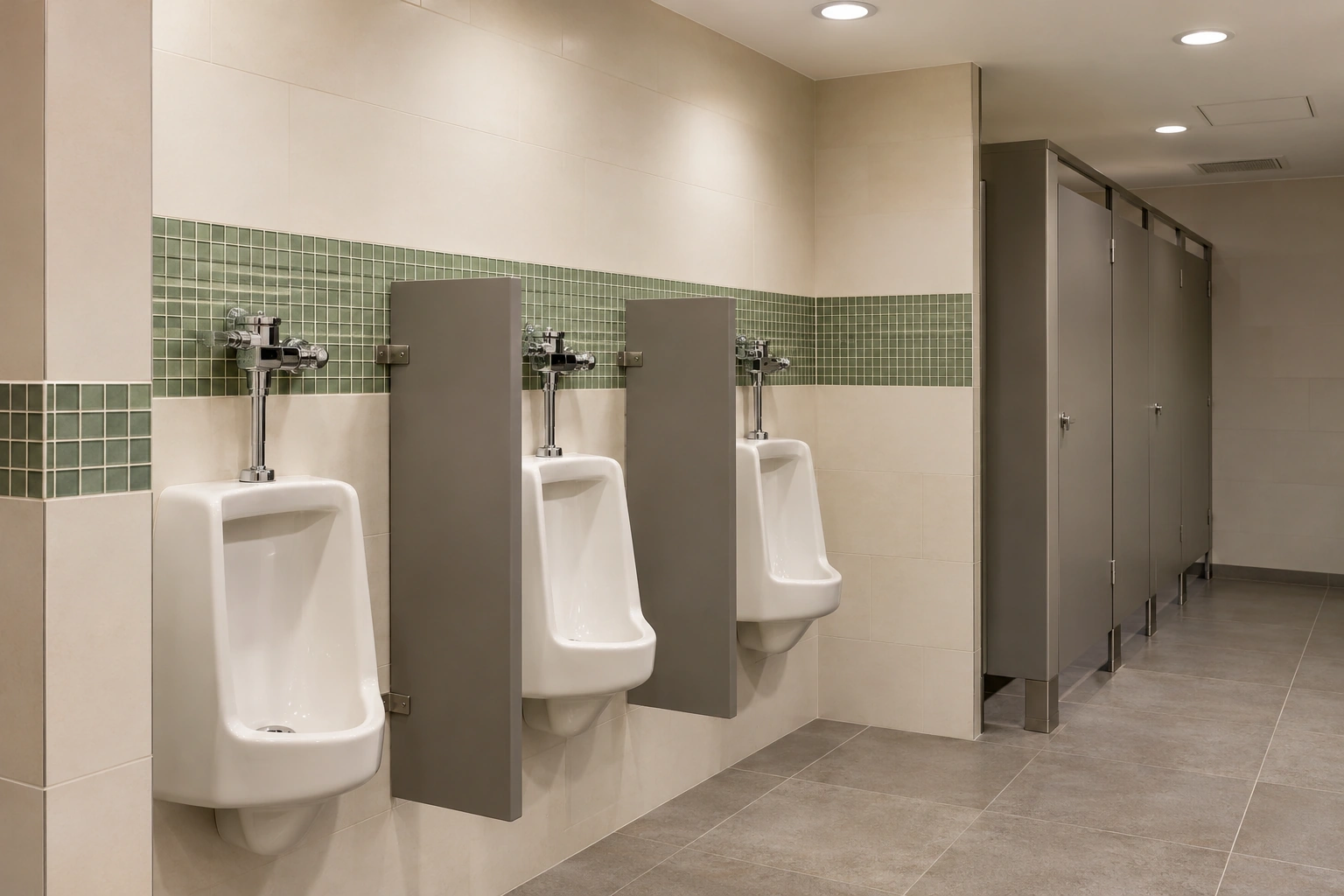
San Francisco restrooms restored on a set cycle: grout scrubbed by machine, scale lifted from every fixture, drains flushed and partitions washed, in everything from high-rise towers to waterfront warehouses.
Restroom care that goes below the surface
On every recurring visit, SF Janitorial cleans restroom fixtures, sinks, mirrors and floors, with soap, paper and liners restocked. That work keeps restrooms usable and presentable day after day. It is not meant to undo slow build-up: scale crusting the inside of urinals, grout that turns darker each season, a film on partition doors and dust settling on exhaust fans overhead.
Restroom deep cleaning is the periodic service that removes all of that. It brings a restroom back to the condition tenants and guests expect, then keeps it there on a cycle that fits how hard the room works.
San Francisco buildings make the case well. A restroom in a century-old loft may still have its original small-tile floor, with decades of grout to restore. A high-rise tower can have two restrooms on every floor, each serving hundreds of people a week. Both need more than a nightly mop. For the tasks that belong on every routine visit, see our commercial restroom cleaning checklist.
What we restore
- Tile and grout machine-scrubbed, then cleared by an auto-scrubber or extraction pass
- Toilets, urinals and sinks descaled, including the far side of each fixture and the seam along the floor
- Floor drains scoured and run clear
- Partitions and stall doors washed edge to edge, wall tile and wainscot included
- Exhaust fans, lens covers and high ledges dusted
- Dispensers, hand dryers and chrome detailed
- High-touch points, from flush valves and faucet handles to stall latches and door pulls, cleaned and then disinfected
- Baseboards, cove tile and the corners a mop misses worked by hand
Commercial restroom deep cleaning, in the order we work
Each visit follows the same order, so nothing gets cleaned twice or missed. The crew posts signs and closes the room, then works from the ceiling down: exhaust fans and vents, light lenses and high ledges, then partitions and wall tile. Fixtures come next, descaled inside and out, followed by the floors and drains, which are scrubbed by machine and flushed clear last so nothing from above lands on clean grout.
With the room clean, dispensers are detailed and refilled, high-touch points get their EPA-registered disinfectant for the label dwell time, and the room reopens. A supervisor carries out a quality inspection on the cycle you set, and the findings shape what the next visit spends its time on.
Odor and disinfection, handled properly
A restroom that smells soon after cleaning has an odor source in the floor: grout near the urinals soaked with splash, a drain holding residue, or the seam at the base of a toilet. Machine scrubbing and a drain flush take care of those spots, so the smell is gone rather than covered. That matters in buildings with small, poorly ventilated restrooms, which are common in older parts of the city.
Disinfection always follows cleaning. Crews then put EPA-registered disinfectants on fixtures and touchpoints, from flush valves and faucet handles to latches, door pulls and dispenser buttons, and keep each surface wet for the dwell time its label lists. Building-wide touchpoint programs are covered on our disinfection and sanitizing page.
How often: weekly, monthly or quarterly
Traffic drives the cycle. A hotel lobby restroom near the front desk or a restaurant restroom on a busy commercial street sees hundreds of visitors a day. A small professional office restroom might serve a dozen people. Each restroom gets the interval it needs.
Weekly, for restrooms open to the public or used by every shift:
- Faucets and fixtures descaled lightly
- Partitions and stall doors wiped
- Drains flushed with fresh water
- Edges scrubbed along every wall
Monthly, for a typical office floor or medical suite:
- Floor and grout machine-scrubbed
- Tiled walls washed
- Exhaust fans dusted
Quarterly, as a full restoration for lighter-use rooms or a seasonal reset:
- Scale removed down to the porcelain
- A deep restoration scrub of the grout
- Each partition and wall washed
- Light fixtures and diffusers cleaned
Across the city
High-rise towers and multi-tenant office buildings see tenants, couriers and visitors from morning to evening, and their restrooms show it first. Hotels carry lobby and banquet restrooms that guests judge the property by. Warehouses and light industrial buildings run crew restrooms that take every shift change.
Bank branches, medical and dental offices, schools, churches, gyms with locker rooms and shower tile, and busy retail shops are all good candidates for periodic restroom care.
Restroom deep clean benefits
- Restrooms that smell clean, without fragrance
- Fixtures and grout that keep their finish longer
- Fewer complaints from tenants, guests and staff
- Rooms you can open to an inspector or a prospective tenant without hesitation
- Restrooms that look as cared for as your lobby
Scheduled around tenants and guests
Deep cleaning is booked for after-hours slots and weekends. In towers and hotels that never fully empty, crews close restrooms in turn so another stays available on the same floor. Each visit fits around your recurring janitorial services, and buildings with heavy daytime use can add a day porter for restroom checks and restocking while the building is busy.
Crews follow your building’s freight elevator and access procedures, just as the recurring team does.
What shapes the price
- How many restrooms and fixtures are on the list
- The scale and staining at the start
- The interval chosen
- Floor and wall surfaces, from vintage tile to porcelain slab
- Access hours and building rules
Wondering whether the lobby restrooms are due? Book a free walkthrough, and we will suggest an interval for each restroom and put the price in writing.
Common questions
How is a deep clean different from the restroom cleaning on our recurring service?
Recurring service cleans fixtures, sinks, mirrors and floors and restocks supplies. Deep cleaning goes further, with grout scrubbed by machine, scale removed from fixtures, drains flushed and every partition and wall washed.
Which parts of a commercial restroom get deep cleaned?
Fixtures descaled, partitions and wall tile washed, floors and grout machine-scrubbed, drains flushed, dispensers detailed and refilled, and high-touch points cleaned and then disinfected.
Can the original tile in an older San Francisco building be deep cleaned safely?
Yes. Crews choose pads, brushes and products suited to vintage tile and grout so the finish is restored without being worn down.
How often does a tower office restroom need a deep clean?
A tower restroom on an ordinary office floor generally holds up on a monthly cycle. Restrooms near lobbies or on heavily used floors add weekly detail work.
What is dwell time, and why does it matter in a restroom?
Dwell time is how long a disinfectant must stay wet on a surface, as stated on its label. Crews use EPA-registered disinfectants and leave them for that full time before wiping.
Why do small restrooms in older buildings hold onto odors?
Limited ventilation lets odor build, and the source is usually grout, drains or toilet bases. Deep cleaning scrubs the grout and toilet bases and flushes the drains, lifting the residue where odor starts.
Services